


20 Years, 3 Technology Eras: What Long-Term Government Partnerships Teach About Building Software That Lasts
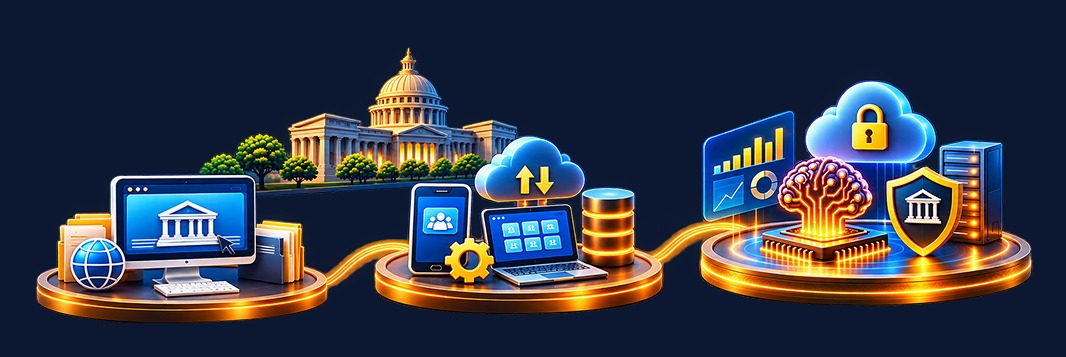


When Insphere started in 2005, the iPhone didn't exist, “the cloud” was a diagram on a whiteboard, and most public-sector software was built to be installed, not subscribed to. Twenty-one years later, we are still working with the institutions that shaped our earliest years: NIC, NeGD and NICSI.
That longevity says something about how software gets built for the public sector, and about what survives. Over two decades, our work has touched programs and institutions across India's digital ecosystem, including Digital India, Bhashini, DigiYatra, CSC, ICMR, and IIT Delhi, and has extended internationally to the Republic of the Gambia. Here is what those partnerships have taught us.
Era One: The Portal Era (2005 to early 2010s)
In the early days, digital government meant getting services online at all. The work was foundational: web portals, content management, databases, and workflows that moved paper processes onto screens.
The constraints were different from today's. Bandwidth was limited. Hosting was physical. A citizen's first digital interaction with the state was often through an intermediary, such as a service center or a kiosk, rather than their own device. Working with NIC, whose infrastructure underpins so much of the government's digital presence, taught us the standards that public-sector systems are held to.
The lesson we took from this era: government software is judged on reliability before features. A portal that is up, accurate and accessible beats a clever one that isn't. We learned to treat uptime, data integrity and clear documentation as the product itself.
Era Two: The Platform and Mobile Era (early 2010s to about 2020)
Then the scale changed. Digital India reframed the goal from “put services online” to “build platforms a billion people can use.” Mobile became the primary screen. Open-source stacks matured and cloud adoption began. Through our association with NeGD, the agency at the heart of the Digital India programme, and with NICSI, which helps government bodies procure and deploy technology, we saw how public digital infrastructure evolves when it has to serve the entire country.
Initiatives such as DigiYatra, which brings digital identity into air travel, CSC's network of village-level service centers, and Bhashini, which works to make digital services available in Indian languages, show what this era demanded. Systems that once served thousands now had to serve millions, across languages, devices and connectivity conditions. Architecture had to shift from monoliths built for a known user base to modular, API-driven platforms built for unpredictable demand.
The lesson here: scale is a design decision, not a hosting upgrade. Systems that scaled gracefully had been designed with clear interfaces, separation of concerns and observability from the start. The ones that struggled had treated scale as something to bolt on later.
Era Three: The AI-Native and Sovereign Cloud Era (2020 to today)
Today's conversation is about intelligent automation, multi-cloud resilience, and data and digital sovereignty. Public-sector teams are asking harder questions. Where does the data live? Who governs the model? How do we avoid lock-in? How do we adopt AI responsibly, with auditability and compliance built in?
This is where the earlier eras pay off. The disciplines that mattered in 2005 (security, documentation, reliability) matter even more when systems make recommendations that affect citizens. Governance cannot be an afterthought when software starts to reason. Work on language technology and national platforms, of the kind Bhashini represents, shows how quickly AI is moving from experiment to public infrastructure.
The lesson of this era: new technology rewards old discipline. The teams that adopt AI well are the ones that already know how to run mission-critical systems.
Six Lessons from Long-Term Government Partnerships
Across all three eras, the same principles kept proving themselves.
- 1. Build for the long tenure, not the launch date. Public systems are expected to run for years, often outliving the vendors, frameworks and teams that built them. We design with maintainability in mind: clean code, thorough documentation, and handover-ready architecture. Our test is simple: could another competent team pick this up tomorrow?
- 2. Trust is the real deliverable.In long partnerships, every release, every incident and every honest status update adds to or subtracts from trust. Being transparent about risks early, including when it's uncomfortable, is what turns a vendor into a partner.
- 3. Security and compliance are design inputs. Government data carries a responsibility beyond commercial norms. Security-first architecture and data sovereignty are not features to add late. They shape the design from the first workshop.
- 4. Technology will change, so avoid dependence on any single one. We have seen stacks come and go. Infrastructure as code, open standards and multi-cloud thinking protect our partners from being trapped by yesterday's choices. Portability is a form of respect for the client's future.
- 5. Operate what you build.Launching is the beginning. Monitoring, patching, scaling and continuous improvement are where reliability is earned. Our Plan, Design, Build, Run approach exists because the “Run” phase is where public trust is won or lost.
- 6. Design for every citizen. Public software serves everyone: different languages, abilities, devices and levels of digital comfort. Accessibility and thoughtful user experience are not polish. They are the requirement.
What the Next Decade Asks of Us
Looking ahead, we expect the next ten years to be defined by three shifts: AI woven into everyday public services, data sovereignty becoming a primary architectural concern, and platforms that are expected to be continuously available and continuously improving. Our work today, across AWS and Google Cloud, enterprise AI, managed platform operations and application platforms, is built on the lessons above.
None of that changes the core principle we learned in 2005. Software that lasts is software built with care for the people who depend on it, the teams who maintain it, and the institutions that answer for it.
Conclusion
We are grateful to NIC, NeGD, NICSI and every institution that has trusted us over these two decades. The partnerships taught us as much as we delivered. For the next twenty years, we intend to keep earning that trust one release at a time.