





Agentic AI Governance: Managing Autonomous Decision-Making Safely


Introduction
Artificial Intelligence is rapidly evolving from systems that simply generate content to systems that can reason, plan, and take actions autonomously. This new paradigm, known as Agentic AI, enables AI agents to execute tasks, make decisions, interact with applications, and coordinate workflows with minimal human intervention.
While Agentic AI promises unprecedented productivity, efficiency, and innovation, it also introduces a critical challenge: governance.
When AI systems can independently make decisions, access enterprise data, trigger business processes, and interact with external systems, organizations must establish robust governance frameworks to ensure accountability, security, compliance, and trust.
This is where Agentic AI Governance becomes essential.
What is Agentic AI?
Agentic AI refers to AI systems that can:
- Understand goals and objectives
- Create execution plans
- Make decisions based on context
- Use tools and APIs
- Execute multi-step tasks autonomously
- Learn from outcomes and adapt behavior
Unlike traditional AI systems that provide recommendations, agentic systems can take actions independently, making them significantly more powerful—and potentially more risky.
Examples include:
- AI-powered customer service agents resolving issues without human involvement
- Autonomous procurement assistants managing vendor interactions
- IT operations agents detecting and remediating infrastructure issues
- Financial agents processing transactions and approvals
- Healthcare assistants coordinating patient workflows
As organizations adopt these systems, governance must evolve from managing AI outputs to managing AI actions and decisions.
Why Traditional AI Governance Is No Longer Enough
Most existing AI governance programs were designed for predictive analytics and generative AI applications. They focus on :
- Model performance
- Bias and fairness
- Data privacy
- Regulatory compliance
- Explainability
However, Agentic AI introduces new risks because agents can :
- Execute real-world actions
- Access multiple systems
- Make sequential decisions
- Operate continuously
- Interact with other AI agents
Traditional governance frameworks often lack mechanisms to monitor and control autonomous actions at runtime. Organizations need governance models that can supervise decision-making while maintaining operational agility.
Key Risks of Autonomous Decision-Making
1. Accountability Gaps
Who is responsible when an AI agent makes an incorrect decision? Without clearly defined ownership and decision rights, organizations may struggle to determine accountability for outcomes generated by autonomous systems.
2. Security and Access Risks
Agentic systems often require access to enterprise applications, databases, APIs, and cloud resources. Poorly governed agents may access unauthorized data, escalate privileges, trigger unintended actions, or introduce cybersecurity vulnerabilities.
3. Compliance Violations
Autonomous agents operating across jurisdictions may inadvertently violate data protection regulations, industry-specific compliance requirements, or internal governance policies.
4. Operational Risks
Agentic systems can make decisions at machine speed. A single error can quickly scale across multiple workflows, creating operational disruptions before humans have time to intervene.
5. Trust and Transparency Challenges
Business leaders need visibility into why decisions were made, what actions were executed, which data was used, and whether policies were followed. Without transparency, enterprise trust in AI adoption diminishes.
Core Principles of Agentic AI Governance
A successful governance framework should be built on five foundational principles.
1. Human Accountability
Humans must remain accountable for AI-driven decisions, regardless of the level of automation. Organizations should establish clear ownership structures, decision approval mechanisms, escalation procedures, and governance committees.
2. Bounded Autonomy
Not every AI agent requires the same level of freedom. Organizations should define autonomy levels such as:
- Assistive: Human approval required for all actions.
- Collaborative: AI can execute low-risk tasks independently.
- Autonomous: AI operates independently within predefined guardrails.
The level of governance should increase with the level of autonomy.
3. Transparency and Explainability
Every significant decision should be traceable. Organizations must maintain decision logs, audit trails, activity records, and action histories. This enables regulatory compliance and supports post-incident analysis.
4. Security by Design
AI agents should operate under least-privilege principles. Key controls include identity management, role-based access controls, credential rotation, tool usage restrictions, and secure API integrations.
5. Continuous Monitoring
Governance is not a one-time activity. Organizations must continuously monitor agent behavior, policy compliance, security events, performance metrics, and decision outcomes. Runtime oversight is becoming a critical component of modern AI governance.
Building an Enterprise Agentic AI Governance Framework
Step 1: Create an AI Agent Inventory
Document all AI agents operating within the organization. Track purpose, data sources, access permissions, business owners, and risk classification.
Step 2: Classify Risk Levels
Categorize agents based on impact:
- Low Risk: Content generation, Internal knowledge assistance.
- Medium Risk: Workflow automation, Customer interactions.
- High Risk: Financial transactions, Regulatory decisions, Healthcare recommendations.
Higher-risk agents require stronger controls and human oversight.
Step 3: Define Decision Boundaries
Clearly specify what decisions agents can make, which actions require approval, escalation thresholds, and exception handling procedures.
Step 4: Implement Governance Controls
Essential controls include policy enforcement, approval workflows, action whitelisting, runtime guardrails, and audit logging.
Step 5: Monitor and Audit
Establish governance dashboards to monitor agent performance, policy violations, security incidents, and business outcomes. Continuous auditing ensures governance remains effective as systems evolve.
The Future of Agentic AI Governance
As organizations move from AI experimentation to enterprise-scale deployment, governance will become a strategic business capability rather than a compliance exercise.
Future governance models will increasingly focus on:
- Agent identity management
- Real-time policy enforcement
- Autonomous risk assessment
- Dynamic trust scoring
- Cross-agent orchestration controls
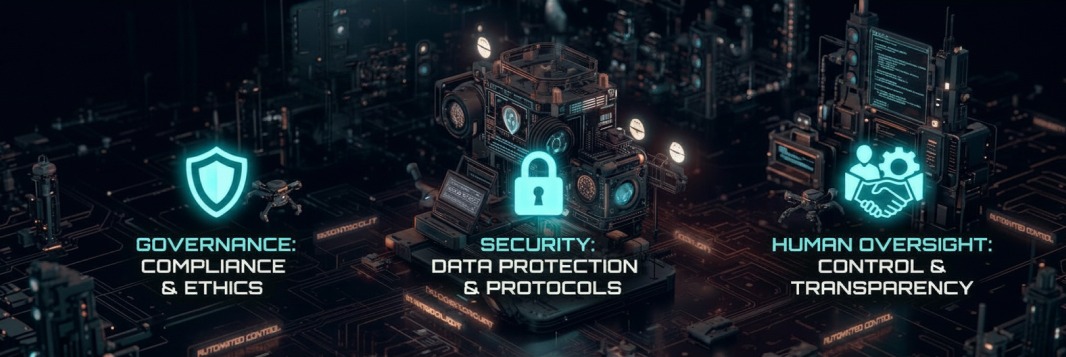
The organizations that succeed with Agentic AI will be those that balance innovation with accountability, enabling autonomous decision-making while maintaining security, transparency, and human oversight.
Conclusion
Agentic AI represents the next frontier of enterprise intelligence, empowering organizations to automate complex workflows and accelerate decision-making. However, with greater autonomy comes greater responsibility.
A well-designed Agentic AI Governance framework ensures that autonomous systems operate safely, ethically, and in alignment with business objectives. By implementing clear accountability structures, bounded autonomy, security controls, and continuous monitoring, organizations can unlock the full potential of Agentic AI while minimizing risk.
As enterprises embrace autonomous decision-making, governance will be the foundation that transforms AI from a technological capability into a trusted business asset.