





AI-Native Software Delivery: The Future of Enterprise Engineering
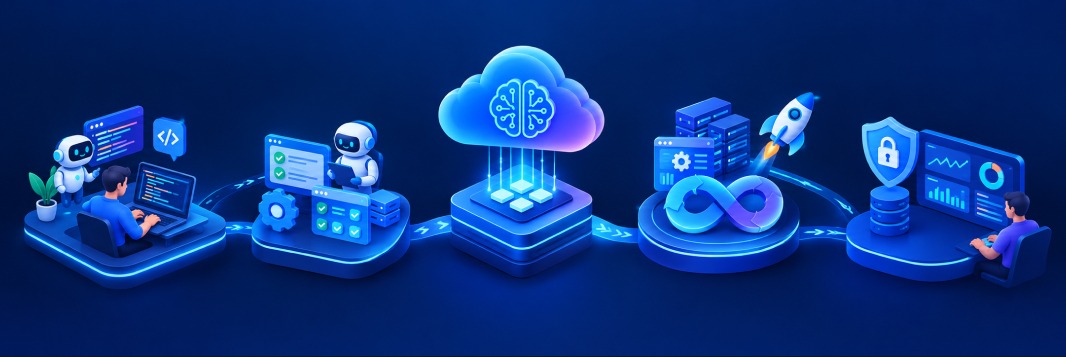


AI-Native Software Delivery & Platform Engineering: Building the Enterprises of Tomorrow
For decades, enterprise software delivery followed a familiar rhythm: plan, build, test, deploy, repeat. AI was, at best, a feature bolted on after the fact. That era is ending. In 2026, the enterprises pulling ahead aren't the ones with the most AI pilots or the flashiest demos — they're the ones that have re-engineered their entire delivery foundation to be AI-native from the ground up.
At Insphere, we see this shift daily across the platforms we build and the teams we work with. This is what it means to be AI-native, why platform engineering is now the backbone of that shift, and how organizations can get there without breaking what already works.
From "AI-Enabled" to "AI-Native"
There's a meaningful difference between adding AI to your stack and building your stack around AI.
AI-enabled software deliveryuses AI as a tool: a chatbot here, a code-completion plugin there, an automation script for a repetitive task. It helps, but it doesn't change the shape of the organization underneath it.
AI-native software deliverytreats AI as a core design principle from day one. Autonomous coding agents assist with feature development, testing, and even security patching. Synthetic user personas simulate real behavior to compress testing cycles. Engineers shift from writing every line of code to defining intent, architecture, and verification — increasingly, seniority means managing agent workflows rather than typing every function.
This isn't a distant future state. It's already reshaping how forward-looking enterprises plan their next three years of technology investment.
Why Platform Engineering Is the Foundation
Here's the part many organizations miss: AI-native delivery doesn't work without a strong platform underneath it.
Handing autonomous agents access to your codebase, your cloud environment, and your deployment pipelines without governance is a recipe for chaos — inconsistent environments, security gaps, and technical debt that outpaces the speed AI was supposed to create. This is exactly why platform engineering has moved from a nice-to-have to a board-level priority for 2026.
A mature internal platform provides the guardrails that make AI-native delivery safe and scalable:
- Golden paths— pre-approved, opinionated workflows that make the right way to build something also the easiest way
- Reusable components— shared services, templates, and APIs that eliminate duplicated effort across teams
- Built-in security and compliance controls— governance baked into the pipeline, not bolted on after a breach
- Self-service toolchains— developers (and their AI agents) provision what they need without waiting on tickets
- Observability by default— every deployment, every agent action, every change is traceable
Industry research increasingly links platform maturity directly to an organization's ability to extract real value from AI investment. In other words: platforms aren't just supporting AI-native delivery — they're the precondition for it.
What This Looks Like in Practice
For an enterprise moving toward AI-native delivery, the shift typically plays out across four layers:
1. Development
AI coding agents handle boilerplate, routine bug fixes, and documentation, while engineers focus on architecture, edge cases, and judgment calls. Early adopters often see a short productivity dip during the transition, followed by meaningful velocity gains once teams and tooling mature.
2. Testing & QA
Synthetic users and AI-driven test generation replace slow manual test cycles, catching issues earlier and reducing the dependency on lengthy human beta cycles.
3. Deployment & Operations
CI/CD pipelines become AI-assisted, with automated risk scoring, rollback triggers, and capacity forecasting layered directly into the release process.
4. Governance
Every layer above is only sustainable with strong platform engineering underneath it: identity, access, cost controls, and compliance enforced consistently, regardless of whether a human or an AI agent initiated the change.
The Insphere Approach
This is the world we build for. Our platform engineering and managed operations practice is designed around exactly this principle — that speed and governance aren't opposing forces, they're two outputs of the same well-engineered foundation.
Whether it's standing up self-service developer platforms, embedding AI-assisted delivery pipelines, or providing the 24/7 operational backbone that keeps AI-native systems running reliably, our focus stays the same: helping enterprises move from experimentation to durable, governed, scalable value — not just another pilot that never leaves the sandbox.
The Bottom Line
AI-native software delivery isn't about replacing engineers with agents. It's about redesigning the delivery system — platform, pipeline, and governance together — so that human judgment and AI capability compound each other instead of colliding. Organizations that get the platform right in 2026 won't just move faster this year. They'll have built the foundation that lets every future AI capability plug in safely, instead of starting from scratch each time.
The question for enterprise leaders isn't whether to adopt AI-native delivery. It's whether their platform is ready to support it.