





Preemptive Cybersecurity & AI-Driven Threat Defense


For two decades, cybersecurity has run on a simple rhythm: detect, respond, recover. An alert fires, an analyst investigates, a patch goes out, and the organization moves on until the next incident.
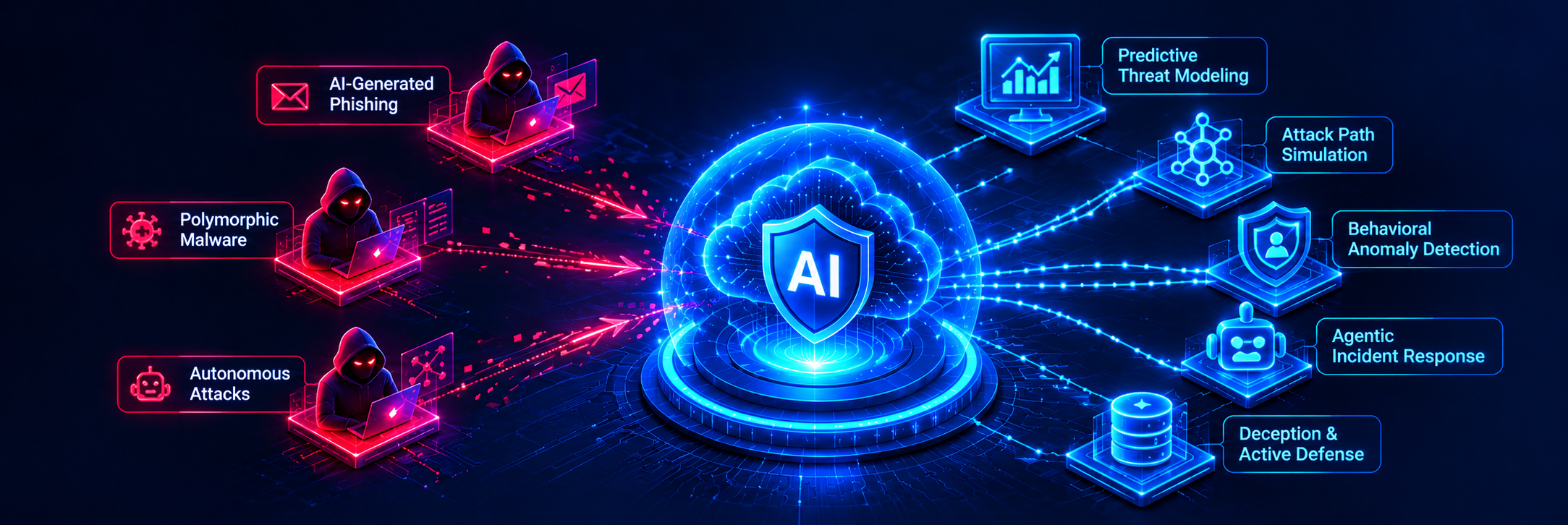
That rhythm is breaking down. Attackers now use the same generative AI and autonomous agents that power modern productivity tools to scale phishing campaigns, write polymorphic malware that rewrites itself to dodge detection, and probe networks around the clock without a human in the loop. Waiting for an alert to decide something is wrong is no longer fast enough.
That's why analysts and security leaders are converging on a new model: preemptive cybersecurity. Instead of waiting to detect and respond to an attack, organizations use AI, automation, and deception to anticipate where and how an attacker will strike — and neutralize the threat before it causes damage.
From Reactive to Predictive: What's Actually Changing
Analysts have named preemptive cybersecurity a defining strategic technology trend, noting that unlike traditional detection-and-response models, preemptive defense systems anticipate, deceive, and neutralize attackers by leveraging automation and AI to predict where and how adversaries will strike.
The forecast is stark: security products that lack preemptive capabilities are expected to lose market relevance by 2028 as enterprises demand proactive protection and resilience.
“Waiting for an alert to decide something is wrong is no longer fast enough. Preemptive defense shifts the battlefield from reactive remediation to predictive neutralization.”
That shift is being driven by three forces converging at once:
1. Attackers Have Industrialized AI
Threat actors are now using generative AI and autonomous agents to scale convincing phishing and impersonation campaigns, deploy polymorphic malware that changes its behavior in real time, weaponize deepfakes for social engineering, and automate exploit chains that lower the barrier to advanced cybercrime.
This isn't theoretical — threat intelligence researchers have warned of a new era of self-evolving, AI-driven malware capable of dynamically altering its behavior to evade detection, and 2025 saw what is believed to be the first large-scale cyberattack carried out with minimal human involvement, using an AI system that autonomously infiltrated global targets.
2. Human-Scale Security Operations Can't Keep Pace
Alert fatigue and analyst shortages mean Security Operations Center (SOC) teams are drowning in signals they can't triage fast enough. Predictive models that flag likely attack paths before they're exploited — rather than after — are becoming a practical necessity rather than a luxury.
3. Boards and Regulators Are Demanding Resilience, Not Just Compliance
Enterprises that adopt preemptive cybersecurity are gaining a decisive edge in reducing risk, improving resilience, and earning greater trust from customers and regulators. Passing an audit is no longer proof that a company is actually safe.
What AI-Driven Threat Defense Looks Like in Practice
Preemptive security isn't one tool — it's a layered strategy built around a few core capabilities:
- Predictive threat modeling:Machine learning models analyze historical incidents and telemetry to forecast likely threat vectors before they're exploited, allowing SOC teams to prioritize alerts and trigger automated initial response workflows.
- Attack path simulation and adversarial emulation:AI continuously maps an organization's exposure the way an attacker would, surfacing exploitable misconfigurations and privilege chains before a real adversary finds them.
- Behavioral anomaly detection: Rather than relying purely on known signatures, AI-driven security tools detect deviations in identity, network, and application behavior to catch novel and identity-based attacks early.
- Agentic incident response:Agentic security tools increasingly automate containment and initial response, helping teams detect faster, respond smarter, and contain threats sooner — while reducing the alert fatigue that burns out analysts.
- Deception and active defense:Decoy assets, honeytokens, and simulated environments waste an attacker's time and expose their tactics before they ever touch production systems.
Crucially, none of this replaces human judgment.The organizations getting the most value are pairing AI-driven tools with a hybrid human-and-AI approach backed by strong governance — using automation to compress the time between signal and action, while keeping people accountable for high-stakes decisions.
The New Attack Surface: Identity, Deepfakes, and the Supply Chain
Preemptive defense matters most where the threat landscape is shifting fastest. Identity-based attacks and credential abuse remain among the most persistent and damaging attack vectors organizations face.
At the same time, deepfake-driven social engineering is turning “verify by video call” into an unreliable safeguard, and AI-assisted reconnaissance is making third-party and supply-chain risk harder to see coming.
Static, perimeter-based defenses were never designed for a threat actor that can convincingly impersonate a CFO's voice or auto-generate a thousand tailored phishing emails in an afternoon. Preemptive, AI-informed defense is what closes that gap.
What This Means for Your Organization
Building a preemptive security posture doesn't require ripping out your existing stack. It means:
- Auditing your current tools for prediction, not just detection:Do they tell you what's likely to happen next, or only what already happened?
- Investing in continuous exposure and attack-path testing: Move away from point-in-time penetration tests toward continuous validation.
- Extending Zero Trust principles to AI systems themselves: The models, agents, and data pipelines your business now depends on are part of your attack surface too.
- Building governance around AI-driven response: Ensure automation accelerates your team without operating outside human oversight.
- Treating identity as the new perimeter: Given how central credential and identity abuse remain to modern breaches, continuous behavioral identity validation is non-negotiable.
How Insphere Can Help
At Insphere, we help organizations move from reactive firefighting to a genuinely preemptive security posture — combining AI-driven threat prediction, continuous exposure management, and hands-on governance so your defenses evolve as fast as the threats do.
If you're evaluating where your current security stack falls short of tomorrow's attacker, we'd welcome the conversation.
Get in touch with our team at connect with us to assess your organization's readiness for AI-driven, preemptive cybersecurity.