





Massive AI Infrastructure Modernization & the Rise of "Cloud 3.0"
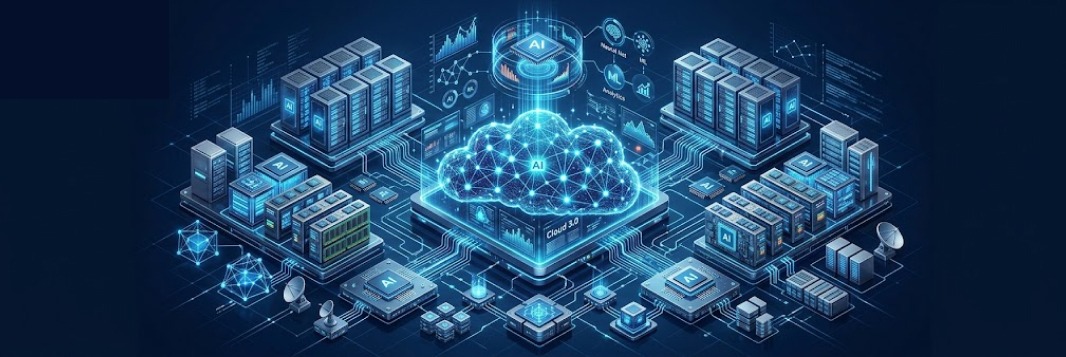


How enterprises are rebuilding their technology foundations for an AI-native future
The Next Infrastructure Shift Is Already Here
Every decade or so, enterprise infrastructure goes through a foundational reset. The first wave was the move from on-premise data centers to the public cloud — "Cloud 1.0." The second wave, "Cloud 2.0," was about hybrid and multi-cloud strategies, containerization, and Kubernetes-driven portability.
We are now in the early, accelerating stages of a third wave: Cloud 3.0 — an AI-native infrastructure model built not just to host applications, but to train, serve, and continuously optimize intelligent systems at massive scale.
This isn't a rebrand. It's a structural shift in how compute, storage, networking, and data platforms are designed, procured, and operated. For enterprises still running Cloud 2.0-era architectures, the gap between "AI-ready" and "AI-native" is becoming a genuine competitive risk.
What Makes Cloud 3.0 Different
Cloud 2.0 was optimized for elastic, stateless, microservices-based applications. Cloud 3.0 is optimized for a fundamentally different workload profile:
- GPU-dense, not CPU-dense. Training and inference workloads demand high-bandwidth GPU clusters, not commodity compute pools.
- Data-gravity-first design. Instead of moving data to compute, modern architectures increasingly move compute to where data already lives — reducing latency, egress cost, and compliance exposure.
- Continuous model lifecycle operations. MLOps and LLMOps pipelines require infrastructure that supports constant retraining, fine-tuning, evaluation, and rollback — not just deployment.
- Interconnect as a first-class resource. Network fabric (InfiniBand, high-speed east-west traffic) is now as strategically important as raw compute, since distributed training performance often hinges on interconnect bandwidth.
- Composable, disaggregated architecture. Compute, memory, and storage are increasingly decoupled and independently scalable, allowing infrastructure teams to right-size for AI workloads instead of over-provisioning general-purpose stacks.
In short: Cloud 3.0 infrastructure is purpose-built for intelligence at scale, not just applications at scale.
Why "Massive Modernization" Is the Right Framing
Many organizations are approaching AI infrastructure as an incremental add-on — a GPU cluster bolted onto an existing environment, or a vector database wedged into a legacy data platform. That approach works for pilots. It breaks down at production scale.
True modernization is happening across five layers simultaneously:
- Compute Layer — Migrating from general-purpose VM fleets to heterogeneous compute pools spanning GPUs, TPUs, and specialized AI accelerators, often across multiple cloud providers and on-prem environments.
- Data Layer — Consolidating fragmented data estates into governed, AI-ready data platforms (lakehouses, feature stores, vector databases) that can feed models reliably and securely.
- Orchestration Layer — Adopting Kubernetes-native AI orchestration (Kubeflow, Ray, Slurm-on-cloud) to manage distributed training and inference at scale.
- Networking Layer — Rearchitecting for low-latency, high-throughput interconnects that support distributed training jobs spanning hundreds or thousands of nodes.
- Governance & FinOps Layer — Building cost visibility and compliance guardrails specifically for AI workloads, where a single misconfigured training run can cost tens of thousands of dollars overnight.
This is why "modernization" alone understates what's happening. It's closer to a rebuild — done in place, without stopping the business.
The Business Case: Why Now
Three forces are converging to make this urgent rather than optional:
- Model economics are shifting. Inference costs at scale — not training costs — are now the dominant long-term expense for most enterprises deploying AI in production. Infrastructure efficiency directly impacts margin.
- Talent and vendor lock-in risk.Organizations that built AI infrastructure ad hoc during the 2023–2024 rush are now discovering technical debt: single-cloud dependency, unmanaged GPU sprawl, and pipelines that don't scale past pilot.
- Regulatory and data sovereignty pressure. AI-specific compliance requirements (data residency, model explainability, audit trails) are pushing organizations toward more deliberate, governed infrastructure design.
Enterprises that treat this as a strategic infrastructure investment — rather than a series of point solutions — are the ones seeing AI initiatives actually reach production and deliver ROI.
What a Cloud 3.0 Modernization Roadmap Looks Like
A pragmatic path typically follows four phases:
1. Assess — Audit existing infrastructure against AI-specific workload requirements: GPU availability and utilization, data pipeline maturity, network topology, and governance gaps.
2. Architect — Design a target-state, composable infrastructure blueprint: multi-cloud or hybrid GPU strategy, AI-ready data platform, orchestration layer, and cost controls — built to scale incrementally rather than requiring a big-bang cutover.
3. Migrate & Modernize — Execute in stages: move foundational data infrastructure first, stand up orchestration and MLOps tooling, then progressively shift workloads from legacy environments to the new AI-native stack.
4. Operate & Optimize — Establish continuous FinOps and MLOps practices so the infrastructure keeps pace with model iteration speed — not the other way around.
The organizations that succeed treat this as an ongoing capability, not a one-time project.
How Insphere Solutions Helps
At Insphere Solutions, we work with enterprises navigating exactly this transition — helping infrastructure and platform teams move from fragmented, pilot-stage AI environments to governed, production-grade Cloud 3.0 architectures. That means:
- Infrastructure assessments benchmarked against AI-native best practices
- Multi-cloud and hybrid GPU strategy design
- Data platform modernization for AI readiness (lakehouse, feature store, vector search)
- MLOps/LLMOps pipeline implementation and orchestration
- Cost governance and FinOps frameworks tailored to AI workloads
Cloud 3.0 isn't a distant future state — it's the infrastructure standard being set right now by the organizations pulling ahead in AI adoption. The question for most enterprises isn't whether to modernize, but how quickly they can do it without disrupting the business they're trying to transform.