





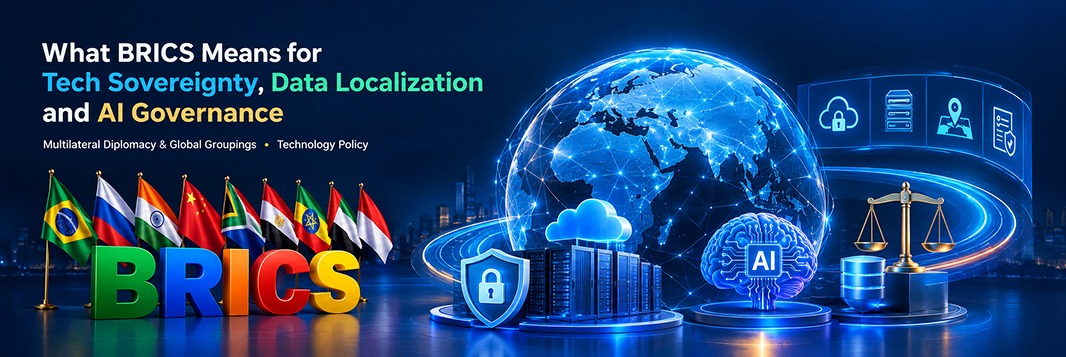
What BRICS Means for Tech Sovereignty, Data Localization and AI Governance


Introduction
For decades, the rules of the digital economy were written in a handful of capitals. Today, that is changing. Governments in the Global South are asking who owns the data their citizens generate, where it is stored, who can access it, and whose values are embedded in the AI systems that shape public services.
BRICS — the grouping that began with Brazil, Russia, India, China, and South Africa and now includes Egypt, Ethiopia, Iran, the UAE, and Indonesia — has become one of the premier forums where these questions are debated. With India chairing BRICS in 2026, the conversation carries particular weight for Indian enterprises, system integrators, and public-sector technology partners.
This article examines what is shifting, why it matters, and how forward-looking organizations can prepare.
1. Why Multilateral Diplomacy Has Moved to the Digital Frontier
Traditional diplomacy centered on trade, security, and finance. Digital issues now sit firmly alongside them:
- Data flows are a trade and security matter as much as a technical one.
- Cloud and AI infrastructure is concentrated in a few jurisdictions, creating dependency risks.
- Standards bodies shape market access and often decide who sets the rules.
- AI models trained on narrow datasets can misrepresent, or simply miss, the languages, contexts and needs of much of the world.
“Groupings like BRICS give emerging economies a collective voice on these issues. They are less about forming a bloc against anyone than about ensuring that digital rules are negotiated with the Global South rather than for it.”
2. Tech Sovereignty: Control, Not Isolation
“Tech sovereignty” is frequently misread as a call for complete autarky or self-sufficiency. In practice, it means having meaningful control, agency, and architectural choice over critical digital infrastructure, without being locked into a single vendor, platform, or geopolitical jurisdiction.
The fundamental building blocks are remarkably consistent across BRICS economies:
Digital Public Infrastructure (DPI)
India's pioneering experience with population-scale identity, instant digital payments (UPI), and consent-driven data-exchange layers (Account Aggregator) has become the benchmark reference model globally.
Domestic Cloud & Compute Capacity
National programmes to stand up indigenous, sovereign, or empanelled cloud infrastructure for mission-critical government databases and vital economic sectors.
Open Standards & Interoperability
Adopting open-source frameworks, vendor-agnostic APIs, and protocol-level integrations to eliminate proprietary lock-in and enable trusted cross-border collaboration.
Local Talent & Ecosystem Resilience
Strengthening national engineering capacity across software architecture, AI research, cyber defense, and semiconductor design.
Sovereignty in this context is about strategic autonomy combined with open international collaboration— not an isolationist retreat from global technology markets.
3. Data Localization: Balancing Control, Security and Openness
Data localization — the mandate that certain categories of data must be stored, processed, or mirrored within national geographic borders — is among the most visible expressions of digital sovereignty.
Why Governments Pursue It
- Law-enforcement access: Expedited domestic legal access and regulatory supervision without diplomatic friction.
- National security: Protecting critical information infrastructure (CII) from foreign interception or supply-chain weaponization.
- Citizen privacy: Safeguarding personal records under domestic legal jurisdiction.
- Domestic economic growth: Stimulating local data-centre, cloud infrastructure, and green power investments.
The Trade-Offs & Operational Costs
- Compliance overhead: Substantially higher infrastructure and audit costs, particularly for startups and mid-market firms.
- Service fragmentation: Incompatibilities between global SaaS offerings and sovereign-only mandates.
- Divergent rules: Managing conflicting jurisdictional mandates across multiple BRICS trading partners.
The Indian Case Study: Layered Obligations
India's regulatory architecture illustrates this nuanced balance. The Digital Personal Data Protection (DPDP) Act, 2023 adopts a largely permissive model for cross-border data transfers, allowing data to flow freely to foreign jurisdictions except those explicitly blacklisted by the government.
Simultaneously, sectoral authorities — such as the Reserve Bank of India (RBI) with payment data — mandate strict, end-to-end domestic localization. This coexistence of a broad statutory framework with sector-specific overlays is typical of emerging economies: organizations must satisfy layered obligations rather than a single checklist rule.
What this means for enterprises:Data classification, residency mapping, and rigorous vendor due diligence are no longer one-off compliance exercises — they are continuous operational capabilities.
4. AI Governance: Toward Inclusive Rules
AI governance is where the multilateral BRICS dialogue has accelerated most rapidly. At the 2025 Rio de Janeiro summit, BRICS leaders adopted a formal declaration on the global governance of artificial intelligence. The declaration underscored that AI governance must be inclusive, that the United Nations should hold a central convening role, and that developing nations deserve an equitable voice in establishing ethical norms and accessing compute infrastructure.
Five recurring themes define these multilateral discussions:
- Inclusion & Capacity-Building: Ensuring developing countries actively author global standards rather than simply consuming rules devised elsewhere.
- Multilingual & Culturally Relevant AI:Investing in foundational models and datasets that serve India's 22 scheduled languages, Africa's linguistic diversity, and regional vernaculars.
- Safety, Transparency & Accountability: Enforcing proportional, risk-weighted oversight for high-impact use cases across public healthcare, social welfare, and financial services.
- Equitable Access to Compute & Datasets: Counteracting the concentration of hyperscaler compute clusters and proprietary training data.
- Interoperable Regulatory Frameworks: Harmonizing principles across borders to prevent a fractured patchwork of mutually incompatible national laws.
India's strategic trajectory — exemplified by the IndiaAI Mission and its hosting of the AI Impact Summit in 2026— demonstrates a commitment to AI for developmental progress and public good, pairing high-velocity innovation with robust ethical guardrails.
5. Challenges to Watch
A realistic assessment requires recognizing the friction points that accompany this transformation:
Diverging Priorities
BRICS member nations possess diverse political systems, privacy traditions, and strategic alliances. Grouping consensus often remains high-level rather than legally binding.
Fragmentation Risks
If localization mandates and AI certification regimes proliferate without harmonization, the cost of cross-border compliance escalates for all participants.
Capability & Supply Gaps
Realizing tech sovereignty demands immense capital investment in specialized talent, clean grid energy, advanced semiconductor fabrication, and high-throughput connectivity.
Security & Digital Trust
Domestic infrastructure is only truly “sovereign” if it is fortified against sophisticated state-level cyber threats, continuously monitored, and resilient by design.
6. What It Means for Organizations Operating in India and Beyond
Whether you lead a government department, a public-sector undertaking (PSU), or an enterprise, six strategic imperatives should guide your roadmap:
- 1. Map Your Data Footprint: Classify every data asset by regulatory sensitivity, business criticality, and residency requirement. Know exactly where your data is ingested, stored, processed, and backed up.
- 2. Design for Cloud Portability: Champion open standards, containerized workloads, and API-first architectures that preserve your freedom to switch providers without crippling rewrites.
- 3. Choose Infrastructure Deliberately: Leverage government-empanelled and compliant cloud providers where mandatory, while engineering hybrid or multi-cloud topologies for global resilience.
- 4. Build In-House AI Governance: Establish model inventories, algorithm risk ratings, audit trails, and human-in-the-loop validation checkpoints well before strict regulatory scrutiny arrives.
- 5. Invest in Certified Security Standards: Rigorous compliance with internationally recognized certifications like ISO 27001, ISO 20000, and CMMI frameworks provides verifiable digital assurance.
- 6. Maintain Policy Vigilance: Digital policy moves rapidly across MeitY, sector-specific regulators (RBI, SEBI, TRAI), and multilateral treaties. Continuous monitoring must be an institutional discipline.
How Insphere Solutions Can Help
At Insphere Solutions, we work with government and enterprise clients on the practical side of this shift. Our CMMI Level 3 and ISO 9001, 20000 and 27001-certified delivery practices support projects where compliance, security and data residency are design requirements from day one. From secure web and portal platforms to data-driven systems and digital public services, we help clients build technology that is compliant, interoperable and sovereign by design.
If your organization is planning a cloud migration, portal modernization or AI initiative and wants to ensure it aligns with evolving data and governance expectations, we would be glad to start the conversation. Contact us: www.inspheresolutions.com
Conclusion
Multilateral forums like BRICS will not dictate the entire future of global digital governance on their own, but they are undeniably shaping the terms of engagement.
For enterprise and technology leaders, the takeaway is unequivocal: sovereignty, localization, and AI governance are no longer abstract geopolitical talking points. They are foundational architectural decisions, core procurement criteria, and lasting competitive differentiators.
The organizations that embrace them today will be best positioned to thrive in a more multipolar, resilient, and regulated digital world.