





Watermarking, Metadata, and Synthetic Content: AI Provenance and Compliance


Watermarking, Metadata, and Synthetic Content: AI Provenance and Compliance
Generative AI has made it trivially easy to produce images, audio, video, and text that are indistinguishable from human-made content. That capability has outpaced something more mundane but arguably more important: a reliable way to tell where a piece of content actually came from.
Over the past two years, the industry's answer to that gap has taken shape around three overlapping mechanisms — watermarking, metadata standards, and provenance labeling — and 2026 is the year they stopped being optional extras and started becoming compliance requirements.
For organizations building or deploying generative AI, understanding how these pieces fit together isn't just a legal exercise. It's fast becoming part of the product spec.
Three Different Tools, One Shared Goal
It's easy to conflate watermarking, metadata, and labeling, but they solve different problems and typically work best together.
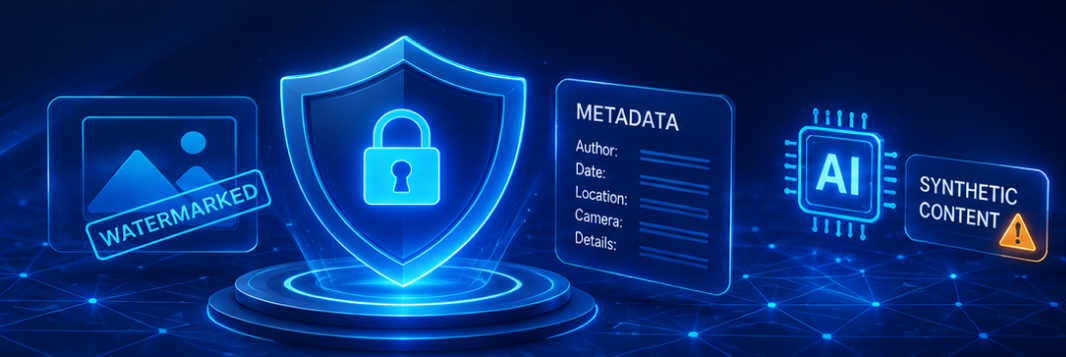
Watermarking embeds a signal directly into the content itself — a pattern in pixel values, a subtle perturbation in audio waveforms, or a statistical fingerprint in generated text. A well-designed watermark survives common transformations like compression, cropping, or re-encoding, and can be detected even after the file's metadata has been stripped. Google's SynthID is the most widely deployed example, now used across Gemini's image and text outputs and expanding into Search and Chrome verification tools.
Metadata and provenance manifests, by contrast, travel alongside the content as structured, cryptographically signed data describing its history: what tool created it, what edits were applied, and by whom. The dominant standard here is C2PA (the Coalition for Content Provenance and Authenticity), now on specification version 2.3, whose "Content Credentials" function like a nutrition label for media — a tamper-evident record of a file's origin and editing history. C2PA's steering committee now includes Adobe, Amazon, Google, Meta, Microsoft, and OpenAI, and more than 6,000 organizations have live implementations of the standard.
Labeling is the human-facing layer: a visible "AI-generated" badge, an audio disclaimer, or an on-screen notice. Labels are what a person actually sees; watermarks and metadata are what a machine reads to verify that label is accurate.
None of these mechanisms is sufficient alone. A visible label can be removed or never applied in the first place. Metadata can be stripped when a file is re-saved or uploaded to a platform that doesn't preserve it. Watermarks can, in principle, be defeated by a sufficiently motivated adversary. That's why the emerging consensus — reflected in both technical standards bodies and regulation — is a layered approach: robust watermarking for detectability, signed metadata for auditability, and visible labeling for transparency.
Where the Technology Actually Stands
Adoption has moved faster on the hardware and creation-tool side than most people realize. Content credentials are now embedded by default in a growing list of places: Adobe Firefly and Creative Cloud exports, OpenAI's DALL·E 3 and Sora outputs, Bing Image Creator, and notably camera hardware itself.
Leica's M11-P was the first consumer camera to embed Content Credentials at capture, and support has since rolled out to professional bodies from Nikon, Sony, and Canon, largely driven by newsrooms that need verifiable photo provenance for editorial use. On mobile, Google's Pixel 10 signs photos with hardware-backed keys, and Samsung's Galaxy S25 attaches credentials to AI-edited images.
Verification tooling has matured alongside creation tooling. Anyone can check whether an image carries a C2PA manifest through the Content Credentials viewer, or inspect one directly with the open-source c2patool. OpenAI and Google have both published 2026 updates describing C2PA conformance alongside SynthID-based detection, with verification previews rolling into consumer surfaces like Search and Chrome.
It's worth being clear-eyed about the limits, though. A missing credential doesn't prove content is fake or AI-generated — it often just means the file was never signed, or the metadata didn't survive a platform's re-encoding pipeline. And a valid signature proves how a file was signed, not that the content behind the signature is what it claims to be; provenance systems have already seen real-world exploits where the cryptography held but the input fed into it was manipulated before signing. Provenance metadata and watermarking are best understood as raising the cost and friction of deception, not eliminating it.
Regulation Has Turned This Into a Deadline
The clearest sign that watermarking and metadata have moved from best practice to requirement is the EU AI Act's Article 50, whose transparency obligations became enforceable on August 2, 2026.
The rule works on two tracks. AI system providers must ensure their outputs are marked in a machine-readable format that's detectable as artificially generated — Article 50(2)'s language is explicit that this can be satisfied through metadata, content credentials, or an embedded signal, not necessarily a visible watermark. Deployers — the organizations that actually publish content — carry a separate obligation under Article 50(4) to add a clear, human-perceptible disclosure in narrower cases, particularly deepfakes and unreviewed AI-generated text on matters of public interest.
Regulators have been candid that no single technical method currently meets the bar on its own, which is why the Commission's June 2026 Code of Practice on Transparency of AI-Generated Content points organizations toward the same layered pattern the industry had already been converging on: signed metadata plus imperceptible watermarking, with fingerprinting as an optional third layer. A further deadline looms on December 2, 2026, for machine-readable marking obligations, and by February 2027 providers are expected to make their watermark-detection mechanisms interoperable — so that content can be verified without querying every vendor's proprietary detector separately.
For organizations serving EU users, or relying on vendors whose outputs reach EU users, this isn't a distant compliance milestone. It's a present-tense engineering and contractual requirement: if you deploy a third-party generative AI system, your own labeling obligations depend on marking you don't directly control, which makes vendor due diligence and contractual guarantees around provenance a real part of AI procurement.
What This Means in Practice
For teams building products on top of generative AI, a few implications are already concrete:
- Provenance is now a pipeline concern, not an afterthought. If your platform ingests, transforms, or republishes media, decide early whether you preserve, strip, or actively verify C2PA manifests as content moves through your systems — because the default behavior of many upload and re-encoding pipelines today is to silently strip metadata.
- Detection is the backstop, not the primary control. Where marking is missing or has been stripped, model-based AI detection remains necessary to meet disclosure obligations on content the upstream mark never covered. Relying solely on the presence of a watermark to make trust decisions is a fragile strategy.
- Vendor selection now has a provenance dimension. Confirming whether an AI vendor conforms to C2PA, supports SynthID-style watermarking, or otherwise commits contractually to machine-readable marking is becoming as material a procurement question as data handling or uptime.
- Labeling design is a UX problem, not just a legal checkbox. Regulators have signaled that burying a disclosure in fine print, or relying solely on an invisible watermark, does not satisfy transparency requirements — the human-facing label has to be genuinely perceptible.
The Direction of Travel
Watermarking, metadata, and labeling are converging into a single expectation: that synthetic content should carry evidence of its own origin, by default, in a form both machines and people can check. The technology is imperfect and the regulatory guidance is still catching up to what's technically feasible — but the trajectory is clear. Provenance is moving from a research topic into infrastructure, the same way TLS certificates or email authentication standards did before it.
Organizations that treat this as core to how they build and ship AI-driven products rather than a compliance form to fill out later will be in a materially better position as verification becomes something users, platforms, and regulators all expect to see.
Insphere Solutions helps organizations navigate the technical and governance side of deploying generative AI responsibly. Get in touch to talk through what content provenance and compliance readiness look like for your product.