


Why Phishing Simulation Is Now Essential
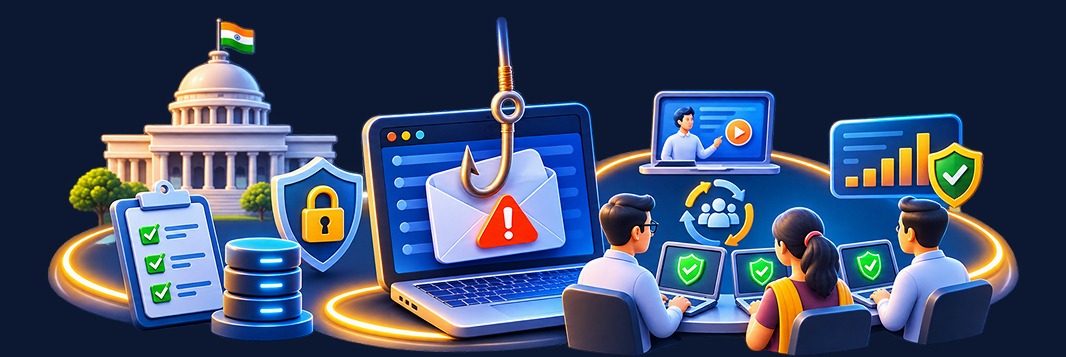


A single convincing email can now do more damage to a government department than a sophisticated malware attack.
Attackers know that firewalls, endpoint protection and email filters keep improving. So they target the one layer that cannot be patched with software: the employee reading the inbox.
For ministries, departments, PSUs and state governments, the stakes are higher than for most organisations. A government mailbox can unlock citizen records, procurement files, internal policy drafts and access to critical systems. That is why phishing simulation has moved from a “nice to have” training exercise to a core part of public-sector cyber defence.
Why technology alone cannot stop it
Email filters and antivirus are essential, but every campaign above was designed to slip past them. Attackers use legitimate cloud services, geofenced downloads and freshly registered domains that no blocklist has seen yet. When the technical layer misses, the employee is the last line of defence.
Government workplaces also have features that attackers exploit:
- Authority and urgency. Staff are used to acting quickly on notices from senior officers, other ministries or tax authorities.
- Shared formats. Circulars, office memorandums and NIC login pages follow familiar templates that are easy to copy.
- Large, varied workforces. Departments include senior officers, field staff, contract employees and outsourced manpower, each with different levels of cyber awareness.
- High-value access. One compromised mailbox can expose citizen data, tender documents and internal systems.
Classroom training and annual awareness lectures help, but people forget them. Behaviour changes only when employees practise spotting real-looking attacks in their own inbox.
How phishing simulation works
Phishing simulation sends safe, realistic test emails to employees and measures how they respond. Nobody is harmed and no real data is at risk. Instead, every click becomes a learning moment and every report becomes a data point.
A well-run programme follows a repeating cycle:
- Baseline. Send an initial round of test emails to find out how many employees click, submit credentials or report the email.
- Realistic scenarios. Use templates that mirror real threats: fake NIC login pages, tax notices, office circulars, tender updates and salary or pension alerts.
- Instant micro-training. When someone clicks, show a short lesson right away explaining the warning signs they missed.
- Reporting culture. Reward employees who report suspicious emails, so the security team hears about real attacks faster.
- Measure and repeat. Track click rates, reporting rates and repeat offenders by department, then run harder scenarios over time.
The result is a measurable drop in risky behaviour, plus dashboards that let senior officers see exactly where their department stands.
Policy now expects it
Phishing awareness is no longer optional for government bodies. Two frameworks make it a compliance matter.
CERT-In guidelines for government entities. CERT-In issued its Guidelines on Information Security Practices for Government Entities in June 2023. They require organisations to run cyber security awareness programmes covering phishing and social engineering. Training must be given to new joiners at induction and to all employees every six months.
The Digital Personal Data Protection (DPDP) Act. The DPDP Rules, 2025 were notified on 14 November 2025. Failure to maintain reasonable security safeguards can attract a penalty of up to ₹250 crore. Most remaining obligations, including security safeguards and breach notification, take effect on 13 May 2027. Since phishing is one of the most common routes to a data breach, a trained workforce is a practical part of those safeguards.
Phishing simulation gives departments something lectures cannot: measurable evidence of awareness, by department and over time, that can be shown to auditors and leadership.
The faster route: procurement through NICSI
For many departments, the biggest hurdle is not deciding to act but buying the service. A fresh tender can take months, while the threats keep arriving.
National Informatics Centre Services Inc. (NICSI), which works under MeitY, gives ministries, departments, PSUs and state bodies access to pre-qualified vendors through its empanelment process. Using an empanelled partner means:
- Less procurement effort. Vendors have already been evaluated, so departments can avoid running a separate open tender for the same service.
- Faster start. Programmes can move from approval to the first simulation campaign much sooner.
- Government-ready delivery. Empanelled partners are used to working within government security, documentation and audit requirements.
Insphere Solutions is empanelled with NICSI for phishing simulation and cyber security awareness training, so government clients can engage us through this established route.
How Insphere helps
Insphere has spent 20 years delivering digital solutions for government organisations, PSUs and enterprises. As a CMMI Level 3 and ISO 27001-certified company, we bring the same security-first approach to protecting your people.
Our phishing simulation and awareness programme includes:
- India-specific scenarios modelled on real threats, such as fake NIC logins, tax notices, office circulars and tender alerts.
- Campaigns at any scale, from a single division to an entire ministry, including contract and outsourced staff.
- Instant micro-learning for employees who click, so every mistake becomes a lesson.
- Department-level dashboards for click rates, reporting rates and improvement over time.
- Compliance-ready reports that support CERT-In awareness requirements and DPDP security readiness.
Conclusion
Your employees are already being tested by real attackers. The only question is whether your department finds the gaps first.